Elizabeth Olsen’s TIFF appearance was pure cinematic seduction—sequins, shadows, and a low-back silhouette that whispered old Hollywood with a modern bite.
Elizabeth Olsen doesn’t just arrive—she materializes. At the 2025 Toronto International Film Festival premiere of Eternity , captured by DJ Quintero, Olsen stepped into a visual narrative that felt lifted from a monochrome dream. The look? A black sequined gown with a plunging back, worn like a secret.
The image, rendered in black and white, strips away distraction and leaves only form, texture, and mood. The gown clings and cascades, sequins catching ambient light like stars scattered across velvet. The silhouette is long and lean, with a low back that dips just enough to suggest drama without veering into excess. It’s the kind of dress that doesn’t need color to command attention.
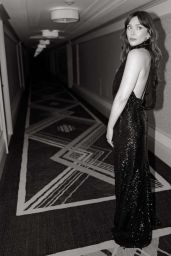
Olsen’s pose—glancing over her shoulder in a softly lit hallway—feels deliberate, almost cinematic. The corridor’s geometric carpet and textured walls add architectural tension, framing her like a character in a noir thriller. Her expression? Controlled, enigmatic, and just a touch defiant.
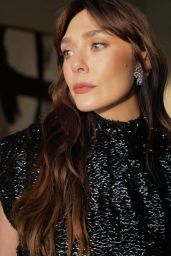
In a companion shot, she wears a black sleeveless top with a glossy, textured finish—paired with wavy brown hair and piercing green eyes that seem to glow against the dim backdrop. The lighting highlights her bone structure and the reflective sheen of the fabric, creating a chiaroscuro effect that’s more gallery than red carpet.
Mia Goth’s TIFF Tribute Awards shoot is a masterclass in modern elegance—her strapless black gown channels vintage glamour with a whisper of gothic restraint.
Mia Goth doesn’t wear dresses—she inhabits them. For her TIFF Tribute Awards photoshoot in September 2025, Goth stepped into a look that felt equal parts old Hollywood and postmodern sculpture. The result? A visual moment that lingers long after the flash fades.
The dress: strapless, black, and textured with a subtle sheen that catches light like lacquered velvet. The fabric appears structured yet pliable, hugging the torso before cascading into a soft, architectural silhouette. A decorative brooch at the waistline punctuates the look—neither flashy nor ornamental, but deliberate. It’s the kind of detail that suggests thought, not excess.


Her pose is poised but unforced—shoulders relaxed, gaze steady, one arm gently behind her back. The lighting, soft and directional, carves out her features while casting gentle shadows across the folds of the gown. It’s a setup that feels more gallery than red carpet, more portrait than promo.
Olga Obumova’s Juem Collection 12 shoot is a quiet rebellion—ribbed textures, undone silhouettes, and a mood that whispers rather than performs.
There’s a certain kind of fashion that doesn’t need to shout. It lingers. It hums. And in Juem Women’s Collection 12, Olga Obumova channels that exact energy—an editorial that trades spectacle for serenity, and polish for presence.


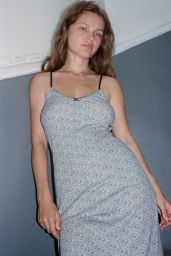
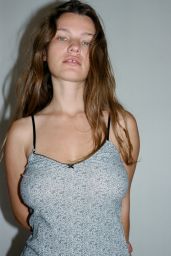

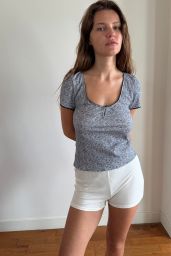
The look: a reddish-brown ribbed crop top paired with high-waisted bottoms, both cut to flatter without clinging. The fabric, likely a cotton-spandex blend, hugs the body with soft elasticity, offering texture without bulk. The top’s thin adjustable straps and subtle V-neckline evoke a 90s minimalism—think Carolyn Bessette-Kennedy, but with a modern, earthy twist.
Obumova’s pose, one hand raised to her head, feels instinctive rather than staged. The lighting is soft, natural, and forgiving—highlighting the ribbed texture and casting gentle shadows that add depth to the monochrome palette. Her long brown hair falls loosely, untouched by styling products or editorial fuss. It’s the kind of hair that moves with the wind, not a stylist’s comb.
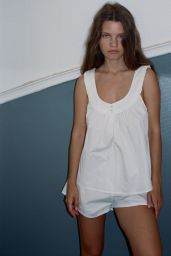
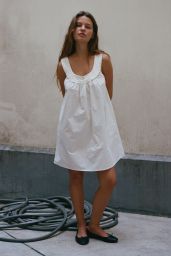
In another frame, she wears a sleeveless white dress with a gathered neckline—loose, breezy, and almost monastic in its simplicity. Black flats ground the look, while the industrial backdrop (a concrete floor, a coiled hose) adds a touch of utilitarian grit. It’s fashion as contrast: clean lines against raw surfaces, softness against structure.
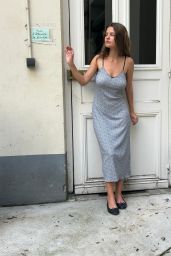
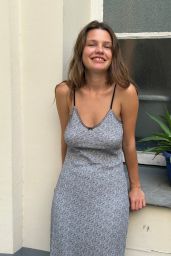
Elsewhere, a light blue ankle-length dress with a subtle pattern and black flats appears in front of a white door—its handwritten French sign (“Merci d’éteindre la lumière en sortant”) adding a charmingly domestic detail. The mood throughout is consistent: quiet, contemplative, and deeply rooted in the kind of celebrity style that favors authenticity over artifice.
