Elle Fanning channels raw survivalism and cinematic edge in SFX’s October issue—grime, grit, and a wardrobe that screams “heroine, not damsel.”
Elle Fanning has always been a chameleon—ethereal in Sofia Coppola’s lens, regal in The Great , and now, feral and fierce in Predator: Badlands . For SFX Magazine’s 30th anniversary issue, she doesn’t just grace the cover—she detonates it.
The central image is arresting: Fanning lying on the ground, eyes wide, body tense, as if caught mid-battle or mid-revelation. It’s not glamour—it’s grit. And it’s exactly what makes this editorial so compelling.





Her wardrobe throughout the spread is utilitarian with a dystopian twist. Think distressed cargo fabrics, tactical layering, and silhouettes that prioritize movement over ornament. In one shot, she’s clutching a weapon with the kind of intensity that rewrites her usual ingénue narrative. The color palette is muted—earth tones, greys, and the occasional flash of metallic hardware. It’s survivalwear, but styled with cinematic precision.
Weapons become accessories in this world—blades, rifles, and makeshift gear slung across her frame like jewelry with purpose. There’s no sparkle, no gloss. Just function. And yet, every strap, buckle, and boot feels curated. The synergy between costume and character is seamless: Fanning doesn’t wear the look, she inhabits it.
The lighting is harsh, directional, and shadow-heavy—evoking the hostile terrain of the Badlands. Fanning’s expressions range from haunted to defiant, her body language taut and reactive. It’s not a fashion shoot—it’s a storyboard for a sci-fi epic.
With Predator: Badlands , director Dan Trachtenberg is steering the franchise into a new era—one that centers emotional depth and world-building over brute spectacle. Fanning’s character, Tía, is a departure from the usual action archetype: vulnerable, volatile, and deeply human. In the SFX interview, she reflects on the physicality of the role and the thrill of stepping into a genre that demands both stamina and soul.
Hair is tousled, damp, and unstyled—more battlefield than blowout. Makeup is minimal, with dirt and sweat replacing contour and highlight. The cohesion is total: every visual element reinforces the narrative of survival, tension, and transformation.
Elle Fanning’s SFX spread is a masterclass in character-driven fashion—where every thread tells a story and every pose feels like a plot twist. For more looks that blur the line between costume and couture, explore our archive of celebrity photos .
So—is this the beginning of Fanning’s action-era evolution, or just a reminder that she’s always had range? Either way, she’s not playing pretty—she’s playing powerful.
An unblinking gaze, a whispered secret—the first look at The Housemaid, starring popular celebrities Sydney Sweeney and Amanda Seyfried, offers a delicious dose of psychological tension and quiet, domestic unease.
A Quiet Thriller of Domesticity
The atmosphere is one of polished disquiet, where the suburban dreamscape gives way to a simmering undercurrent of control. In one frame, Sydney Sweeney—her character’s name is unconfirmed—sits before a towering dollhouse, a perfect miniature world reflecting the one she inhabits. Her expression is a mix of defiance and weariness, her gaze unyielding as she faces the camera.
The visual storytelling is sharp. In the first image, Sweeney wears a simple, ribbed long-sleeve top in a soft gray. Its texture, a subtle play on light and shadow, mirrors the delicate yet complex power dynamics at play. The silhouette is casual, fitted but not restrictive, a costume of domesticity that seems to hide more than it reveals. She wears her hair in loose, natural waves, framing her face and emphasizing a vulnerability that feels both intentional and unsettling.

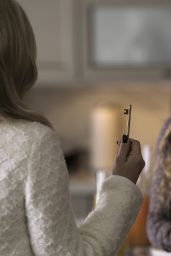

In another image, Amanda Seyfried, appearing as the mysterious owner of the house, hands Sweeney a key. Seyfried is out of focus, a deliberate choice that makes the golden key the central object of the shot—a symbolic transfer of authority. The moment suggests the transactional nature of their relationship and the claustrophobic world of secrets they share.
The third still is perhaps the most captivating. Sweeney, in a simple green tank top and denim jeans, cleans a marble vanity. She is reflected in the mirror, but the image is doubled. In the background, Amanda Seyfried’s character watches her, a ghostlike figure in the reflection, her face a mask of silent scrutiny. This is a masterclass in visual tension, the reflection-within-a-reflection creating a sense of being perpetually watched, and a reminder that every action is a performance in this house. The styling here is utilitarian—gloves, a duster—but the way Seyfried looms in the background transforms a mundane task into something charged with suspense.
With its calculated wardrobe and moody setting, the film’s celebrity fashion seems to be a character in itself—quietly telling a story of power, surveillance, and the hidden dangers that lurk behind closed doors.
Naomi Scott brought structured elegance and editorial edge to Deadline’s TIFF studio—oversized tailoring, noir minimalism, and a pose that said: leading lady, no question.
Naomi Scott doesn’t need a red carpet to command attention. At the Deadline Studio during the 2025 Toronto International Film Festival, she turned a plain white backdrop into a fashion moment—proof that presence, not props, makes the picture.
In a sea of TIFF glitz and cinematic buzz, Scott’s look was a quiet rebellion: all-black, all-attitude, and all about silhouette. It was the kind of outfit that doesn’t beg for headlines—it earns them.
She wore an oversized black button-up shirt with voluminous sleeves, paired with high-waisted black trousers that elongated her frame and sharpened the silhouette. A large black tie anchored the look, adding a masculine edge that felt more Comme des Garçons than corporate. The fabrics were matte, structured, and deliberate—no gloss, no fuss. It was tailoring as armor, and Scott wore it like a shield of cool.
No jewelry, no embellishment—just black high heels with a clean finish, letting the outfit’s geometry do the talking. The synergy was stark and striking: every piece served the same purpose, to amplify Scott’s quiet intensity. Her pose—one hand on the hip, the other relaxed—was confident without being performative.
