Kaitlyn Dever attends the TV Academy’s inaugural Televerse Festival, unveiling a dramatic and effortlessly cool black ensemble that redefines red carpet elegance.
On a red carpet often saturated with color, Kaitlyn Dever attended the TV Academy’s inaugural Televerse Festival in Los Angeles on August 16, 2025, with an unapologetic and intentional approach to monochrome. The look was a quiet triumph of texture and silhouette, a striking blackout moment that proved the power of a single shade.

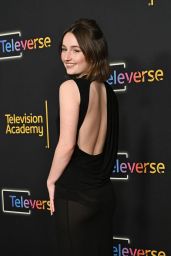
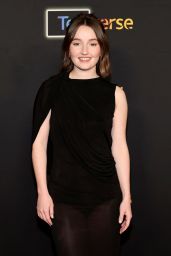
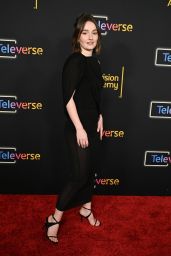

Dever’s outfit, a Magda Butrym Asymmetrical Draped Midi Dress in Black, was a study in controlled deconstruction. The top half featured a beautifully draped, high-neck bodice with one sleeve falling away in a soft cape-like panel, creating a sense of fluid motion even in a static pose. This effortless draping, a signature of the designer, gave the look a sense of modern art—a sculptural piece that moved with her. The skirt transitioned into a sheer, almost transparent panel from the mid-thigh down, revealing a hint of leg and adding a touch of edgy allure. It was a subtle, clever play on perception, a tease of what lies beneath a seemingly simple facade.
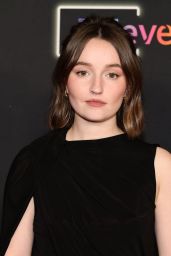
She completed the ensemble with black Duha BB Sandals, their delicate straps crisscrossing the ankle, adding a final, refined touch. The styling was a masterclass in cohesion: her hair was styled in a casual, slightly messy bob, framing her face and lending an air of approachable cool. Her makeup was minimal and dewy, letting her natural beauty shine through, a stark but perfect counterpoint to the dramatic dress.
Jessica Alba unveils a masterclass in effortless, cool-girl style while out with her son Hayes—a lesson in how to fuse comfort with high-fashion sensibility.
Spotted in Los Angeles on August 16, 2025, Jessica Alba delivered a compelling argument for elevated, yet approachable, off-duty style. The actress and entrepreneur, known for her polished red carpet presence, proved that her fashion sense is just as sharp when the cameras are off.
Her look was a symphony of oversized proportions and classic streetwear staples, all brought together with a clear eye for detail. The centerpiece was a slouchy, gray bomber jacket—a piece that exuded an air of laid-back cool without sacrificing structure. Worn open, it revealed a simple white tank top, creating a clean, high-contrast base for the rest of her ensemble. The juxtaposition of the fitted top with the loose jacket and wide-leg jeans was a clever play on silhouette, giving the entire outfit a sense of balance.
The jeans themselves were a key component of the look: a dark-wash, baggy denim that cascaded down to her sneakers. This relaxed fit, a clear nod to the ’90s and early ’00s, felt both nostalgic and utterly current. Her accessories were equally thoughtful. A simple baseball cap anchored the look, adding a sporty, no-fuss element. The ensemble was elevated by her choice of accessories: layered necklaces that added a touch of feminine sparkle and a practical, yet stylish, black crossbody bag.
A decade after its release, Black Swan (2010) endures not just as a psychological thriller but as a stark visual text—a gothic fairytale told through fabric and movement.
Revisiting Darren Aronofsky’s Black Swan isn’t just a masterclass in cinematic tension; it’s a dive back into a world where fashion, costume, and character are inseparable. The film’s aesthetic, crafted by costume designer Amy Westcott, remains a sharp, almost painful study of duality. The visual language is immediate and visceral, and the outfits are central to the narrative.
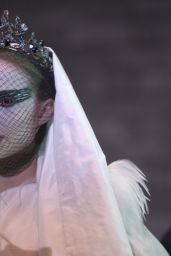


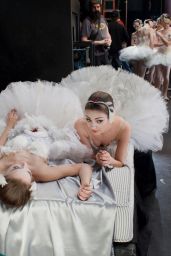

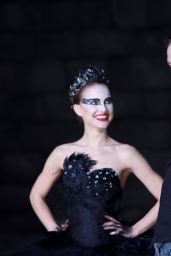
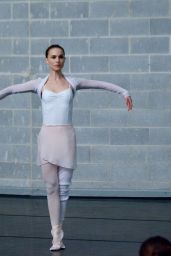

Consider Natalie Portman as Nina Sayers, transforming into the White Swan. Her costume is a vision of ethereal purity—a stiff, intricately feathered tutu that billows out from her torso. The delicate, almost fragile-looking bodice is a mosaic of beading and lace, a perfect reflection of Nina’s initial innocence and disciplined precision. Paired with the iconic feathered headpiece and a shimmering tiara, it’s a look that feels both historic and hauntingly contemporary. The makeup is precise, almost severe, with a stark winged eye that foreshadows the darkness to come.
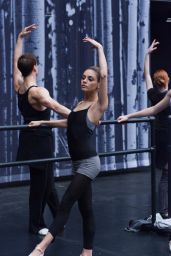
Then there’s Mila Kunis as Lily. On-screen, her look is a masterclass in off-duty dancer style: a mix of relaxed, almost-grunge practice wear that hints at a carefree, effortless nature. In behind-the-scenes images, we see her in black tank tops, gray athletic shorts, and worn leggings—a stark contrast to Nina’s pristine ballerina aesthetic. This casual, street-style approach to dancewear became an unexpected trend, proving that even a rehearsal room can become a runway. It was a subtle fashion coup—Lily’s outfits signaled a freedom that Nina craved but couldn’t attain.
The film’s aesthetic is an immersive, almost suffocating experience. The costumes aren’t just worn; they are extensions of the characters’ psychological states, a metaphor for the struggle between light and dark, control and abandon. The transition from pristine white to the dramatic, feathered black of the Swan Queen costume is a cinematic rite of passage.
