Lily James traded dainty for defiant at TIFF—her oversized plaid suit was pure power dressing, with a hint of undone elegance and a whisper of rebellion.
There’s something thrilling about watching a star shed her signature softness for something sharper. At the Deadline Studio during the 2025 Toronto International Film Festival, Lily James stepped into a look that felt more boardroom than ballroom—and it worked. Think Katharine Hepburn meets downtown London cool.
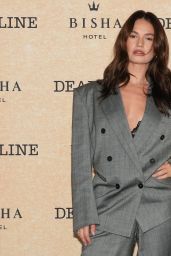
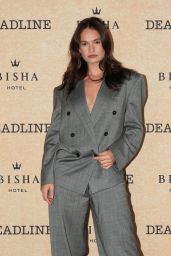
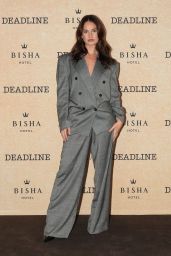
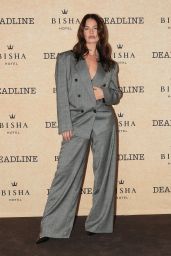
Her outfit: a grey plaid double-breasted suit, oversized in all the right places. The blazer, worn sans shirt, created a plunging neckline that balanced structure with sensuality. The shoulders were pronounced, the cut boxy, and the fabric—likely wool or a brushed suiting blend—held its shape with architectural precision. The wide-legged trousers pooled slightly over black pointed-toe shoes, grounding the look in classic tailoring while nodding to 2020s streetwear proportions.
It’s a silhouette that’s been gaining traction in celebrity fashion circles—oversized, gender-fluid, and unapologetically bold. But James made it her own with subtle styling choices: no visible jewelry, no handbag, no distractions. Just the suit, the stance, and the attitude.
Her hair, long and wavy, cascaded over her shoulders with a lived-in texture that softened the suit’s severity. Makeup was kept neutral—matte skin, brushed brows, and a muted lip—allowing the outfit’s geometry to take center stage. Her pose, one hand on the hip and the other relaxed, radiated confidence without veering into stiffness. It was red carpet minimalism with editorial edge.
Olga Obumova’s Juem Collection 12 shoot is a quiet rebellion—ribbed textures, undone silhouettes, and a mood that whispers rather than performs.
There’s a certain kind of fashion that doesn’t need to shout. It lingers. It hums. And in Juem Women’s Collection 12, Olga Obumova channels that exact energy—an editorial that trades spectacle for serenity, and polish for presence.
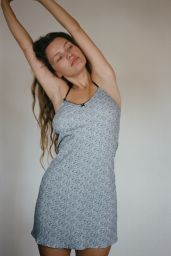
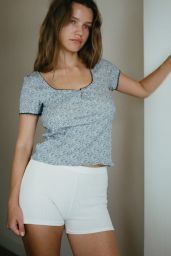
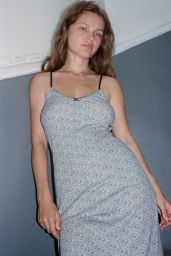
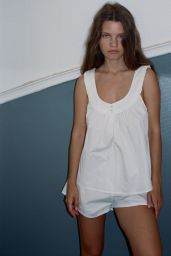
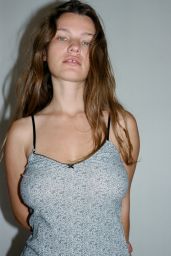
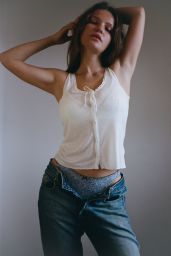
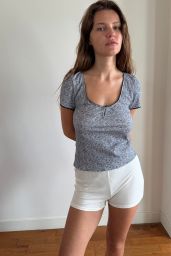
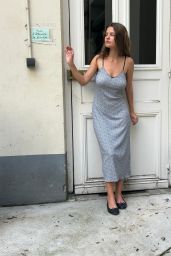
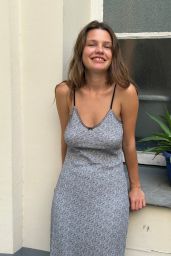
The look: a reddish-brown ribbed crop top paired with high-waisted bottoms, both cut to flatter without clinging. The fabric, likely a cotton-spandex blend, hugs the body with soft elasticity, offering texture without bulk. The top’s thin adjustable straps and subtle V-neckline evoke a 90s minimalism—think Carolyn Bessette-Kennedy, but with a modern, earthy twist.
Obumova’s pose, one hand raised to her head, feels instinctive rather than staged. The lighting is soft, natural, and forgiving—highlighting the ribbed texture and casting gentle shadows that add depth to the monochrome palette. Her long brown hair falls loosely, untouched by styling products or editorial fuss. It’s the kind of hair that moves with the wind, not a stylist’s comb.
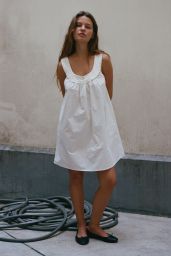
In another frame, she wears a sleeveless white dress with a gathered neckline—loose, breezy, and almost monastic in its simplicity. Black flats ground the look, while the industrial backdrop (a concrete floor, a coiled hose) adds a touch of utilitarian grit. It’s fashion as contrast: clean lines against raw surfaces, softness against structure.
Elsewhere, a light blue ankle-length dress with a subtle pattern and black flats appears in front of a white door—its handwritten French sign (“Merci d’éteindre la lumière en sortant”) adding a charmingly domestic detail. The mood throughout is consistent: quiet, contemplative, and deeply rooted in the kind of celebrity style that favors authenticity over artifice.
Lily James brought architectural elegance to TIFF’s Getty Studio—her asymmetrical skirt and layered neutrals felt like a Bauhaus sketch reimagined for 2025.
There’s a quiet thrill in watching an actress known for romantic period dramas pivot into something sharper, more sculptural. At the Getty Images Portrait Studio during the 2025 Toronto International Film Festival, Lily James did just that—trading corsets and chiffon for a look that felt like it was carved from shadow and light.
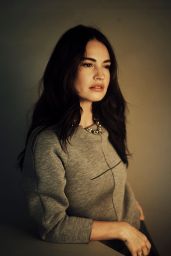
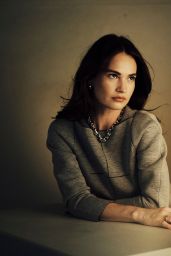
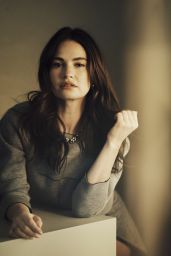
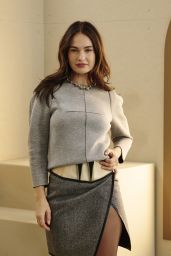
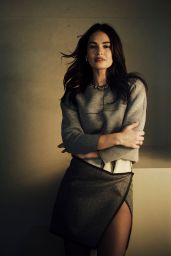
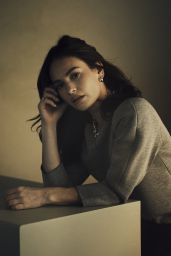
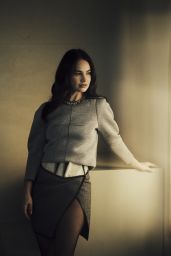
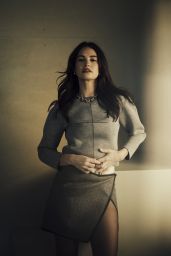
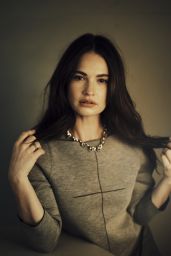
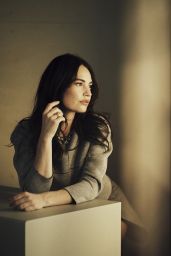
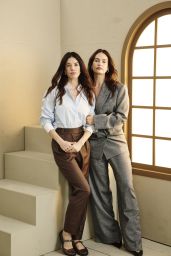
Her outfit, a study in tonal layering, centered on a structured grey top with long sleeves and a subtle sheen. The fabric—possibly a wool-silk blend—held its shape with architectural intent, framing her shoulders and torso like a minimalist armor. Beneath it, a white blouse peeked out, softening the silhouette with a hint of classic tailoring.
But the real punctuation came from the skirt: dark grey, asymmetrical, and slit high to reveal a lighter inner panel and black tights. The contrast wasn’t loud—it was deliberate. The black trim traced the hem like a line drawing, adding graphic tension to an otherwise fluid composition. It’s the kind of skirt that moves like a sculpture in motion.
Accessories were kept minimal but intentional. A decorative necklace added a touch of metallic glint, catching the soft indoor lighting that bathed the beige walls and arched window behind her. Her hair, long and brown, fell naturally around her shoulders, while her makeup leaned neutral—earthy tones, brushed brows, and a muted lip that let the outfit speak.
