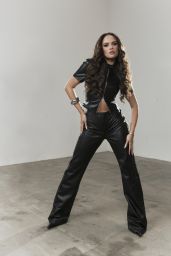
Across a minimalist set, Pettis merges cutout mechanics and glinting zip closures—her sculptural leather duo riffs on ’90s rebellion and modernist polish.
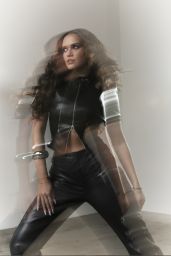
Madison Pettis appears almost forged from obsidian, the sheen of her black leather ensemble gliding across a stark white backdrop. The zip-front top hugs her torso with high-collar authority and a triangular midriff cutout that teases a flash of skin. Each metallic snap along the sleeves and collar whispers industrial chic—an elegant nod to the machinery of power dressing.
Her high-waisted pants mirror that tonal command, button-lined seams running down the sides like rivets on a streamlined chassis. The silhouette is simultaneously militant and sensual, the nipped waist giving way to a subtly flared leg. As she plants her feet, legs splayed in a stance worthy of a runway’s closing walk, the ensemble feels less garment and more armor.
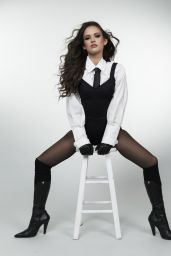
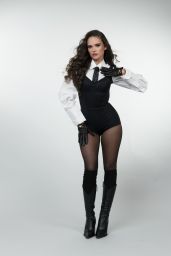
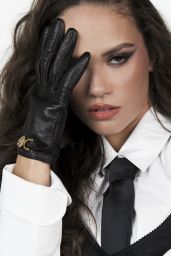
Then—you might blink—a sleek metamorphosis. In one frame, Pettis trades head-to-toe leather for a contrasting black-and-white ensemble: a crisp white dress shirt, a slim black tie, and a sculpted sleeveless bodysuit layered atop. Black sheer tights and knee-high zipper boots shoot the look into defiant opera, while fingerless gloves complete the femme-fatale equation.
This photoshoot doesn’t just play with contrast; it champions it. By juxtaposing texture-heavy leather with hospital-white cotton, Pettis taps into a broader resurgence of duality—think Y2K minimalism meets ’80s noir. Her wavy hair drapes around her shoulders like ink on paper, and a bold eye punctuates the look (why whisper when you can announce?).
Every accessory, from the subtle bracelet at her wrist to the glint in her metallic bangle, punctuates the narrative of modern sartorial warfare. For more on how celebrities are rewriting style rules, explore our celebrity style .
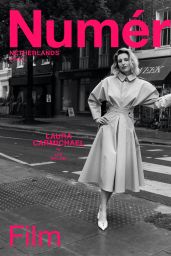
For Numéro Netherlands, Carmichael leans into cinematic restraint—rain-slick streets, razor tailoring, and a gilded waist (because restraint loves one good flourish).
Laura Carmichael meets the lens like a quiet siren—no shout, all signal. On the “Film” cover, she anchors a rain-darkened street in a long-sleeved, belted dress with a flared skirt and pointed heels, one hand hooked to a streetlamp as if calling the scene to order. The black-and-white palette sharpens the line: trench-adjacent structure up top, swing and movement below, the stance set to “cut—print.”
Shift scenes and color bleeds in. Against a black-painted facade, Carmichael wears a deep green satin blouse with voluminous sleeves and a cinched waist, the look clinched by an ornate gold buckle that reads baroque punctuation. Wide-leg teal trousers drop with studio-perfect weight; pointed brown shoes extend the silhouette with that sly, lengthening finish. The palette? Jewel tones without the noise—inked, urbane, unhurried.
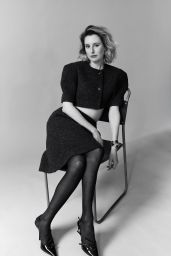
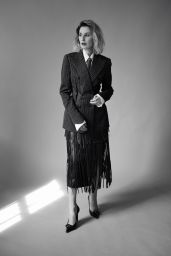
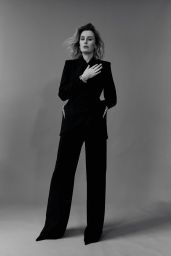
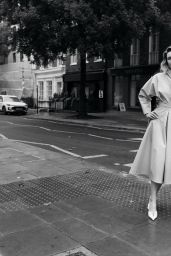
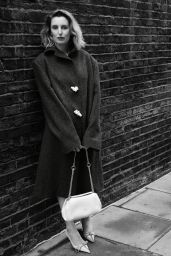
Back in the studio, the narrative goes vertical. A pinstripe double-breasted blazer with structured shoulders sits over a crisp shirt and tie, but the twist lands below: a skirt cut into long, swaying strips, turning stride into motion graphics. The pointed heels restore severity; wavy hair softens the line—precision drafting meets after-hours fringe. It’s boardroom codes rewritten for a dolly shot.
Accessories stay sparse and strategic: the statement belt buckle in look two carries the visual thesis, while the cover’s minimalism relies on architecture and attitude. Lighting does the heavy lifting—overcast city gloss for the opener, soft window-sheen for the green-and-teal vignette, high-contrast studio chiaroscuro for the pinstripe—and Carmichael calibrates her posture to each: grounded and cinematic; louche and leaning; erect, almost editorially still.
What does it all reference? Film noir’s urban choreography and midcentury tailoring, trimmed with a hint of ’70s gloss and ’90s minimalism. Think streetlamp as co-star, trench codes distilled, and fringe-as-motion blur—a suite of frames rather than outfits. Hair and makeup keep tempo: softly waved lengths and clean, camera-minded detailing that appears designed to respect line and shape rather than steal focus.
If this is Carmichael’s fall mood board, consider us cast—though we’ll allow for one reshoot if that fringe skirt gets a sequel on a real sidewalk.
Explore more looks shaping the season in our curated hub for celebrity photos .
Sawai channels architectural angles and tactile sheen—her satin silhouettes and dramatic bows stage a conversation between modernist precision and Old Hollywood glamour.
Anna Sawai steps into frame as if carved from satin itself, each drape and dart playing off the stepped geometries of her backdrop. Her white slip dress unfolds in a cascade of bias-cut panels, one thigh-baring slit and one-shoulder drape merging to form a study in asymmetrical elegance. Black strappy heels anchor the look, their thin lines echoing the vertical flutes of the wall behind her. With a slight arch in her stance and that knowing half-smile, she makes minimalism feel momentous.
Moments later, Sawai reappears in a sculpted black gown that seems to whisper Old Hollywood glamour into a contemporary corridor. The one-shoulder silhouette is punctuated by a lavish, origami-like bow at the shoulder—statement-making party armor in textured sequin. Under the soft hallway light, the fabric shimmers like moonlit water, turning each tilt of her chin into its own spotlight. A single, bold earring peeks from beneath her sleek hair, the only punctuation in this monochrome manuscript.
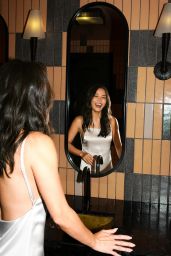
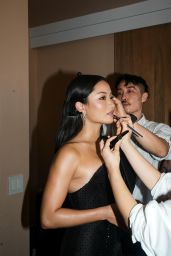
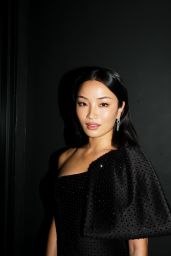
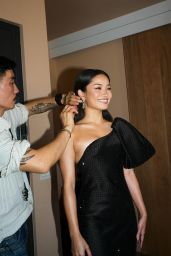
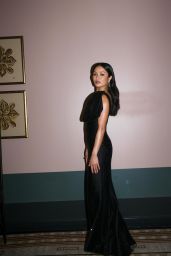
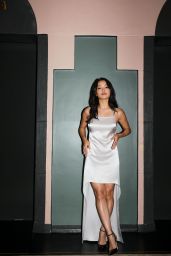
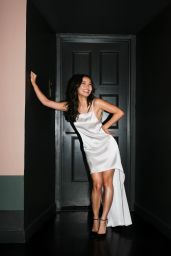
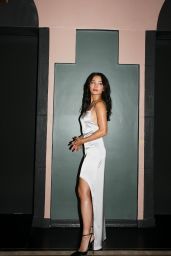
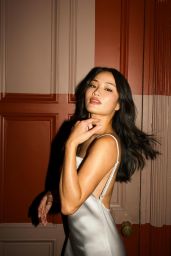
This pared-back simplicity speaks to a broader revival of slip satin and architectural shoulders on the awards circuit. From Y2K’s understated sheen to ’80s contoured power dressing, Sawai’s duo of looks feels like a timeline where past and future coalesce. These aren’t borrowed references or forced nostalgia—they’re fresh translations, proof that a whisper of sculpted drama can resonate louder than any printed riot.
Every element—from that razor-sharp center part to the dewy, barely-there glow—works in concert. Sleek locks fall like a dark frame around her face, while a hint of bronze on the cheekbones hooks the light. It’s a masterclass in cohesion: when glow and geometry fuse, the mood shifts from pretty to purposeful.
For more on how today’s stars are reinterpreting couture classics, explore our celebrity style .
Will Sawai’s sculptural satin symphony echo beyond Emmy week—or will this melody be her most magnetic encore (and our closets’ next craving)?
