Olivia Holt proved that understated elegance is the new statement-maker at the US Open, where her head-to-toe black column dress—paired with an effortless, sun-kissed glow—served as a masterclass in modern celebrity style.
There’s a quiet confidence in knowing exactly how little it takes to command attention. Olivia Holt, arriving at the US Open Tennis Championships in New York City on September 3, 2025, embodied this philosophy with a look so refined it bordered on radical. No embellishments, no fuss—just the kind of effortless sophistication that makes you wonder why everyone isn’t dressing this way.
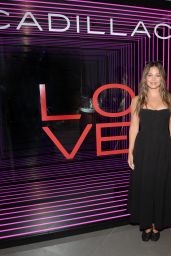
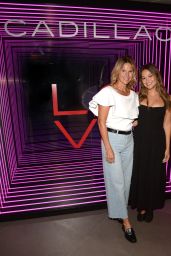
Holt’s floor-length black dress was a study in precision: strapless, body-skimming, and cut with a high slit that offered just a hint of movement. The fabric—a matte, almost liquid jersey —clung to her frame like a second skin, its simplicity belying the meticulous tailoring required to achieve such a flawless drape. The absence of hardware or embellishment let the dress’s architecture speak for itself, a testament to the quiet power of a well-cut garment. It was the kind of piece that felt both timeless and urgently modern, a uniform for the woman who knows the impact of restraint.
Holt’s approach to accessories was equally edited. A pair of strappy black heels , their thin straps echoing the dress’s minimalist lines, elongated her silhouette without competing for attention. Her only jewelry? A delicate ring and a pair of barely-there studs, the kind of details you only notice because everything else is so deliberately pared back. Even her sunglasses—perched atop her head like an afterthought—felt intentional, a nod to the off-duty cool of a woman who’s always camera-ready but never trying too hard.
Dakota Johnson doesn’t just wear velvet—she weaponizes it. In her latest Grazia Italia spread, the actress trades Hollywood’s red carpet glitter for something far more dangerous: a velvet dress cut with the precision of a surgeon’s blade, bows tied like secrets, and a gaze that could melt a camera lens. Is this the birth of quiet provocation? Or just Dakota, yet again, rewriting the rules of celebrity style?
Dakota Johnson’s Grazia Italia September 2025 cover story isn’t just a photoshoot—it’s a manifesto. The centerpiece? A black velvet dress that clings to her frame like a second skin, its deep V-neck plunging into a trio of satin bows, tied with the nonchalance of a woman who knows the power of a well-placed knot. The fabric, rich and matte, swallows light whole, save for the electric blue of the bows— cyan arrows pointing straight at the heart of convention. The dress, with its puffed short sleeves and knee-grazing hem, is a study in contrasts: demure cut, rebellious texture. It’s the kind of piece that whispers in a room full of shouts, the sartorial equivalent of a raised eyebrow.


The styling is deliberate in its undone-ness. No statement jewelry, no towering heels—just a pair of delicate diamond studs and hair tousled as if she’s just stepped out of a convertible, wind still tangled in the strands. Her makeup? Barely-there, save for a swipe of mascara and lips left naked, as though she’s daring you to look closer. This isn’t dressing up; it’s stripping down to the essentials, then adding a single, subversive flourish.
This shoot arrives at a pivotal moment in Johnson’s career. Fresh off the heels of her romantic comedy Material Love —where she plays a director grappling with the chaos of love, art, and Chris Martin’s fictionalized alter ego—the actress is in the midst of a professional renaissance . In the Grazia interview, she muses on the absurdity of fame , the pressure to be “likable,” and the quiet thrill of playing characters who refuse to be boxed in. The velvet dress, then, isn’t just fabric and thread; it’s a metaphor. Soft to the touch, yes, but impossible to pin down.
Johnson has long been a master of sartorial subversion . Recall her 2023 Gucci campaign, where she paired a prim Peter Pan collar with leather gloves, or her 2024 Met Gala moment —a gown that looked demure from the front and daringly backless from behind. This Grazia spread feels like the next evolution: a look that’s both vintage and futuristic, romantic and a little bit dangerous. It’s as if she’s channeling the spirit of Jane Birkin by way of a cyberpunk heroine , a woman who knows the value of a well-timed pause .
For more on Dakota’s ever-evolving sartorial journey, dive into our celebrity style archives.
Jenna Ortega doesn’t just wear the night—she commands it, as proven in Sophy Holland’s haunting new portraits for Wednesday Season 2, where Victorian mourning meets modern menace (and we’re utterly transfixed).
There’s a moment, frozen in the glow of candelabras and the weight of history, when Jenna Ortega’s portrayal of Wednesday Addams transcends costume and becomes something far more potent. The newly released portraits for Wednesday Season 2, lensed by Sophy Holland, don’t merely capture a character—they bottle the essence of gothic romance, reimagined for an era obsessed with both nostalgia and subversion. This isn’t just celebrity fashion ; it’s a masterclass in how to wield fabric, silhouette, and attitude as weapons of quiet rebellion.
Ortega’s ensemble is a study in contrasts: the severe, high-necked black dress—reminiscent of 19th-century mourning gowns—is rendered in layers of sheer and opaque fabric , creating a play of concealment and revelation. The voluminous skirt, structured yet fluid, cascades like ink spilled across marble floors, its mesh panels offering glimpses of skin beneath. The sleeves, puffed and dramatic, echo the silhouettes of a bygone era, but the sheer gloves add a contemporary edge, a whisper of vulnerability beneath the armor. The dress, custom-designed for the role , clings to Ortega’s frame like a second skin, its deep V-neckline a daring slash of modernity against the otherwise puritanical cut.
No Addams look is complete without its macabre flourishes. Here, the accessories are sparse but deliberate: a choker, tight and unadorned, circles her throat like a shadow, while her arms remain bare save for the gloves—no rings, no bracelets, nothing to distract from the dress’s hypnotic pull. The only concession to ornamentation? The chandelier beside her , its crystals catching the light like a scatter of shattered stars, a silent accomplice to the drama
