Sydney Chandler leans into cinematic nostalgia—her frilled blouse and ribbon tie evoke a bygone elegance that feels freshly relevant (and quietly rebellious).
Sydney Chandler doesn’t just wear an outfit—she curates a mood. In this FX & Vanity Fair Pre-Emmys portrait, she’s captured mid-lean against a wooden structure, framed by golden light and vintage textures. The result? A look that feels like a still from a 1970s arthouse film, reimagined for 2025.
Her blouse—a sheer white piece with frilled cuffs and a black ribbon tie—evokes the romanticism of Belle Époque tailoring, filtered through a punk-adjacent lens. The black buttons add punctuation, while the slightly translucent fabric (likely organza or chiffon) softens the sharpness of the silhouette. It’s Victoriana meets Patti Smith.
Paired with high-waisted black trousers, the look balances drama with discipline. The trousers are tailored, possibly wool or crepe, and cut to elongate the leg without overwhelming the blouse’s delicacy. It’s a masterclass in proportion play.
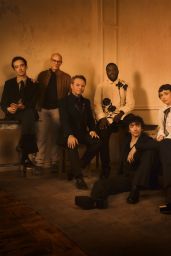
Molly Gordon sprawls across vintage floorboards in a black blazer and sultry top—her FX Vanity Fair portrait channels moody glamour with a cinematic pulse.
There’s a moment in every fashion cycle when restraint meets rebellion—and Molly Gordon’s FX & Vanity Fair Pre-Emmys portrait nails that intersection with unapologetic flair.
Lying across a rustic wooden floor, Gordon wears a black blazer layered over a revealing top that hints at lingerie but lands firmly in editorial territory. The blazer, matte and structured, evokes classic menswear tailoring—think Helmut Lang or early Saint Laurent—while the top beneath adds a whisper of seduction, possibly satin or mesh, though the lighting keeps its secrets.
No accessories interrupt the visual tension. No jewelry, no visible shoes—just Molly, the outfit, and the room. And what a room: amber lighting, aged walls, a wooden table and chair that feel plucked from a 1970s arthouse set. The composition is painterly, almost Caravaggio-esque in its chiaroscuro drama.
Her pose—reclined, limbs relaxed but deliberate—suggests a woman in control of her narrative. It’s not passive; it’s performative. She’s the subject and the storyteller.
Hair and makeup are obscured, but that only adds to the mystique. This isn’t about polish—it’s about presence. The image feels like a still from a lost Cassavetes film or a moody editorial in early 2000s W Magazine.
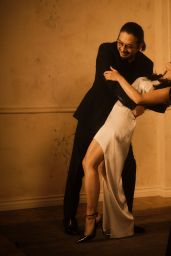
Anna Sawai leans into quiet power—her thigh-slit silk dress and poised stance fuse softness with edge at the FX & Vanity Fair Pre-Emmys gathering.
There’s a kind of cinematic tension in this portrait—Anna Sawai, half-perched against a wooden table, her dress cascading like liquid light, her gaze cool and composed. It’s not just a look; it’s a mood.
The dress, a pale, silky number with a thigh-high slit, evokes the ease of 1930s bias-cut gowns but with a modern twist. The fabric appears to be satin or charmeuse, catching the warm lighting like a whisper of moonlight. The silhouette is fluid yet intentional—draped to flatter, slit to provoke.
Her black high-heeled shoes anchor the softness with a touch of noir. No visible jewelry interrupts the visual rhythm, allowing the dress and pose to speak uninterrupted. It’s restraint as strategy.